

The Art of Returning: A Modern Guide to Natural Harmony

Updated: May 5
Do you arrive at this page tired, perhaps?
Modern life can be so exhausting sometimes. Your mind hums with the residue of obligations and screens. Work, health, finances, relationships, goals, it never seems to end.
This is not unusual. Everyone experiences the pressure to perform and be better. The contemporary landscape has arranged itself in such a way that exhaustion becomes the norm, disconnection the default setting.
But understand this: you are not broken. Maybe you are just out of tune.
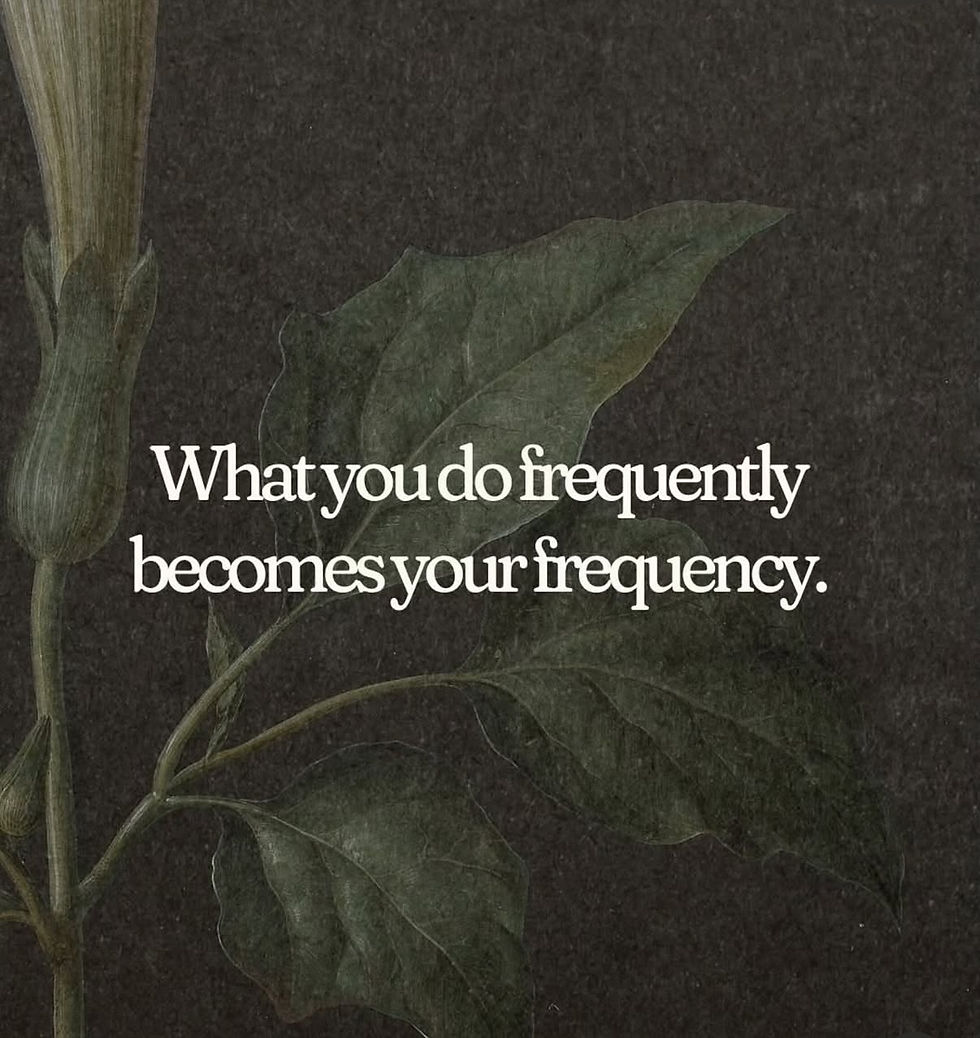
On Being a Frequency
The ancients understood something we have conveniently forgotten in our rush toward productivity. They knew that a human being is not a machine requiring optimization but rather a resonance seeking its proper pitch. When you feel that particular heaviness in your chest, that scattering of attention, you are experiencing dissonance, not failure.
The body knows things the mind has been trained to ignore. Your fatigue is not weakness but information. It tells you that you have been living at odds with your nature, which is to say, at odds with nature itself.
Consider sitting quietly somewhere, anywhere. Ideally in the nature - sit in the grass or under a tree. Feel the weight of yourself against the earth. Breathe as if breathing mattered, because it really does. Focusing on our breath is all it takes to be present in our bodies. Five seconds in through the nose. Hold for three. Seven seconds out through the mouth. This is a simple way of remembering that you are a biological creature, not a thought having a body but a body capable of amazing thoughts. Sometimes too many. There’s a way to be still and let the way of thoughts float on by like the clouds in the blue sky, with you merely an observer.
The Way That Cannot Be Forced
There exists in Chinese philosophy this notion of the Tao, which we might translate as the Way, though that translation flattens something that refuses to be flattened. The Tao is not a path you choose so much as a current you join. Water does not force itself downhill. It finds the way because it is already going there.
You have been taught to paddle upstream, to overcome, to achieve. And there is nothing inherently wrong with effort. It’s good to try but sometimes it’s better to relax and let it flow naturally.
There is something fundamentally exhausting about constant resistance to what is. The ocean does not apologize for its tides. The wind does not justify its direction.
What if you stopped trying quite so hard to control outcomes and instead paid attention to what wants to happen? Not passively, but with the same alert relaxation of a cat watching birds. Present, attentive, but not wound tight with desperate intention.
The Three-Part Creature
You are, whether you acknowledge it or not, a three-part being: body, mind, spirit. Most of us live almost entirely in our heads, that echoing chamber of commentary and judgment. Meanwhile the body carries its load of unprocessed experience, and the spirit, whatever we mean by that, gets no say at all.
Integration is not complicated. It requires only that you stop fragmenting yourself. Breathe with intention. Eat food that grew somewhere, ideally somewhere nearby. Sleep when you are tired. Touch things: trees, stones, fabric, skin. Let your senses gather information directly rather than mediated through representation.
The body wants to move. Let it. The mind wants to rest. Let it. The spirit wants connection to something larger than the narrow confines of ego. Let it.
Where Energy Goes
The Taoists speak of Qi, life force - the animating principle. We need not adopt their entire cosmology to recognize a simple truth: attention is a finite resource, and where it goes, vitality follows.
You leak energy through worry about things that have not happened. You leak it through resentment about things that have. You leak it into screens that promise connection while delivering only simulation of connection.
What if you stopped the leak? What if you gathered your attention the way you might cup water in your hands? This does not require renunciation of the world. It requires only that you notice where you are giving yourself away for nothing in return.
The Forgotten Tools
You own everything you need already. Stillness costs nothing. Laughter, that great dissolver of false seriousness, is free. Water remembers how to heal; it has been doing so longer than we have had words. Movement, the kind that feels good rather than punishing, exists independent of gym memberships. Sound, your own voice humming, vibrates through your chest and reminds you that you are solid, here, real.
These are not techniques to master but capacities to remember. You knew them once. Every child knows them. Then we learn to ignore the body’s signals in favor of the mind’s schedules, and we forget.
On Taking It Lightly
The temptation exists to make even the practice of presence into another grim duty, another item on the list of self-improvement projects. This misses the point entirely.
The Taoists, those old tricksters, knew that seriousness is often just fear in a respectable costume. What if you approached the whole thing playfully? What if you grinned at the absurdity of being a conscious animal on a spinning rock, here for no particular reason, gone again soon enough?
This isn’t nihilism necessarily, just a new pragmatic perspective. The stakes are both impossibly high and utterly meaningless, and holding both truths simultaneously produces freedom rather than paralysis.
Becoming the Still Point
The goal, if we must have one, is not enlightenment in some dramatic sense. It is simply this: to become someone whose presence offers others a moment of quiet. Not through preaching or fixing but through being someone who has stopped adding to the general panic.
You become this by practice. By saying less and noticing more. By letting your breath regulate itself. By treating trees as if they were old friends, because at some fundamental level of biological memory, they are.
A Parting Thought, for now…
The world will insist that you hurry. That you produce. That you become more than you are. This is the world’s job, apparently. It has always done this.
Your job is simpler: to return, again and again, to what is actually here. This moment. This breath. This body that has carried you faithfully through everything you have survived.
You are not a problem requiring solution. You are a rhythm that has temporarily lost the beat. And now, perhaps, you remember where to find it.
Go walk barefoot somewhere, if you can. The earth has been waiting.


Comments